A two rack-space answer to a very old question
Avalon Design released the VT-747SP in 2001 as the stereo sibling to the VT-737SP, and it has outlived almost everything released alongside it. The premise is simple and unusually well executed: a Pure Class A stereo optical compressor with a spectral sidechain, an all passive six band programme equaliser built from discrete high voltage transistors, and a switchable valve path that lets you choose the character of the amplification stages without changing anything else about the routing. Everything in and out of circuit is handled by twenty-two sealed silver-contact relays, so a bypassed section is genuinely out of the audio path rather than simply turned down.
That relay based routing is the detail most reviews skip past, and it is the reason the unit behaves like mastering equipment rather than a channel strip with ambitions. You can compare in and out honestly, and you can trust that what you hear is the section you engaged.
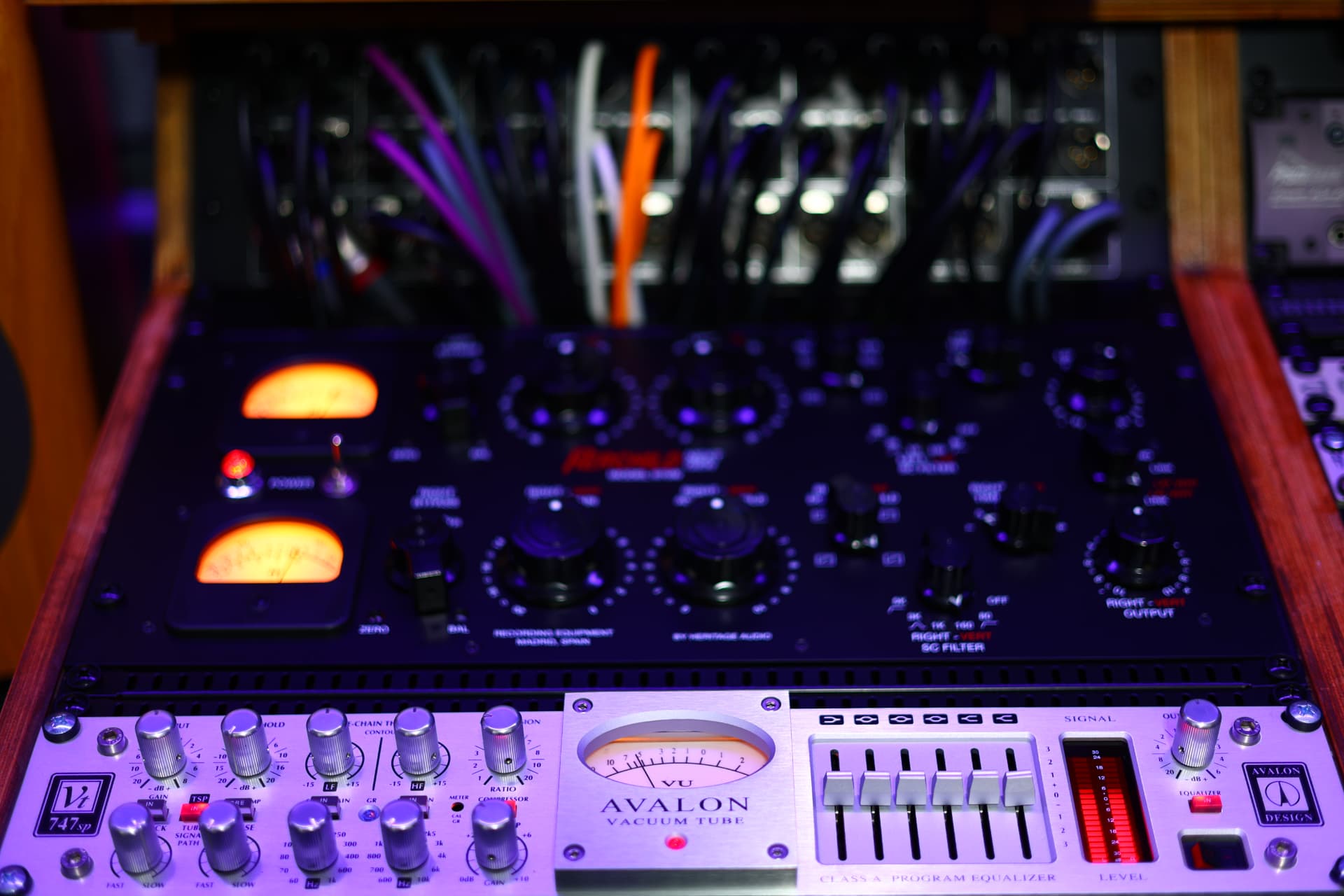
The opto-compressor
Gain reduction is performed by a passive optical attenuator rather than a VCA or a valve variable-mu stage. The cell does the level control; a Class A variable gain make-up amplifier then restores the level. Because the attenuator is passive, the compressor adds very little of its own noise or grain - the tonality you hear comes from the make-up amp and the output stage, not from the detector.
The control set is more comprehensive than the classic opto boxes it is often compared with:
- Threshold continuously variable from -20 dB to +20 dB
- Compression ratio from 1:1 through to 20:1, soft compression to hard-knee limiting
- Attack from 1 ms to 200 ms
- Release from 50 ms to seven seconds
- Make-up gain on a Class A variable gain amplifier
- Gain reduction shown on a single large analogue VU, summed L+R, with a blue LED that catches the first fraction of a dB the meter misses
The attack and release ranges run slightly faster at the quick end than the 737SP's compressor, which matters: it can be set to genuinely catch peaks, not only to breathe.
The spectral sidechain
This is the feature that earns the unit its rack space. Two parametric contour sections - one low, one high - can be routed into the detector path, each with its own frequency and threshold control, so compression can be made frequency-dependent without any of it appearing in the audio path.
Set the high contour and the detector stops responding to sibilance and cymbal transients, or starts responding to them exclusively, depending on which way you take it. Set the low contour and kick and bass energy can be removed from the detector so the whole programme stops ducking on every downbeat. An SC Listen mode monitors the sidechain directly, which turns setting it up from guesswork into something you can actually hear.
Six band passive programme EQ
The equaliser is all passive, using 100% discrete Class A high voltage transistors for the make-up amplification. Turnover frequencies, Q and amplitude range were chosen band by band for musical balance and minimal phase shift rather than for a tidy octave spacing on a spec sheet. The six fixed bands are:
- 15 Hz - sub-bass weight and room lift, below where most EQs bother to reach
- 125 Hz - body and warmth
- 500 Hz - the honest midrange, and the band that decides whether something sounds boxed in
- 2 kHz - presence and forwardness
- 5 kHz - definition and edge
- 32 kHz - the famous one; an air shelf sitting so far out that what you hear is the tail of it, which is exactly why it never sounds harsh
The faders are centre-detented at 0 dB, and the whole EQ can be placed either before or after the opto-compressor. Pre compressor, the EQ changes what the detector reacts to. Post compressor, it shapes what the compressor has already done. Both are useful; they are not interchangeable.

TSP - the twin signal path
TSP swaps three military grade high voltage dual triodes in and out of the opto-compressor and primary output stages, exchanging them for discrete Class A transistor amplifiers. Same unit, same settings, two different amplification characters, selected by relay.
The valve path adds harmonic density through the midrange and rounds the leading edge of transients. The discrete path is faster, cleaner and more linear. Neither is a "better" setting - the point of the design is that the choice is a tonal decision made per programme, in seconds, without repatching.
Specification
- Pure Class A discrete signal path throughout, fully balanced input, DC-coupled output
- Three military spec dual triode vacuum tubes, high voltage and high current
- Frequency response -3 dB from 1 Hz to 200 kHz
- Noise better than -92 dB, 20 kHz unweighted
- Headroom +36 dB before overload, with a +10 dB input button for -10 dBV sources
- Twenty-two sealed silver relays for all routing, plus true hard-wire bypass
- Stereo 60 dB high resolution output metering alongside the analogue GR VU
- Internal discrete regulated power supplies
- 2U, stainless steel chassis
How it sits in our chain
It lives on the Maselec MTC-2 as a colour insert rather than a fixed link in the chain, and it is chosen for what it does to tone and density rather than for gain control. The passive EQ and the twin signal path are the reason it is patched in; the compressor is used when the programme asks for it, with the spectral sidechain doing the work that a broadband detector would get wrong. Which sections are engaged, and in which order, is a decision made per record.

Hardware info
Avalon never discounted the 747SP into the amateur bracket and the used market has not softened it much either. A genuinely Class A, valve equipped, relay routed stereo processor built to this standard remains a serious purchase - which is precisely why so few rooms have one across the bus.
Hear it on your record
Book a master
This chain is available on every stereo and stem master we deliver from Manchester.