The console everything passes through
Every record that leaves Dimension Mastering goes through the Maselec MTC-2. It is not an accessory in the chain, it is the chain. Leif Mases built the MTC system in Berkshire around a single idea: the transfer console should add nothing and take nothing away, while giving the engineer total command over source selection, insert order, stereo image and monitoring. Ours is the three unit stereo system, Master Control, Monitor Control and Master Router, wired as a single instrument at the centre of the desk.

Three boxes, one instrument
The Master Control is the part we touch. The Monitor Control owns the listening path. The Master Router carries the power supplies, the front panel patch field and every send and return in the room, so the audio wiring stays short and the front panel stays clean. The two control units run from remote regulated DC fed out of the router, with control on RS232 style 25 way D-sub links rather than audio wiring, so nothing switching related ever rides on the programme path.
Input section
Four analogue sources feed the Master Control, each with plus or minus 10 dB of trim, phase reverse and cut on both channels. That trim is the reason our A and B comparisons are honest: level is matched at the front of the console, so you hear processing rather than volume. A low cut filter sweeping 20 Hz to 100 Hz and a high cut filter sweeping 12 kHz to 27 kHz sit just before the inserts, cleaning subsonic rumble and ultrasonic rubbish before any processor sees it. Digital sources are handled by a passive four into one AES selector, D1 to D4, feeding the converter of choice.
Six inserts, hard switched
The six inserts are hard switched. No buffer, no amplifier, no electronics of any kind are added to the audio when a box is in circuit, and nothing is left in the path when it is out. That is the whole point of a Maselec: you can stack five or six pieces of outboard in series and the console itself stays silent.
- Any insert out of circuit still receives a parallel Insert Feed B, so compressors stay warm, tubes stay biased and every box is available for instant comparison
- Inserts 1 and 2 switch to sum and difference, putting the left channel on the mid and the right on the sides, so an EQ, compressor or de-esser can work on the centre or the sides alone
- Insert 6 can be moved post fader, landing after the output section but before the record feeds, which is where a limiter or a final safety stage belongs
- Insert order is chosen at the router patch field, so a chain can be reordered in seconds without touching a cable behind the rack
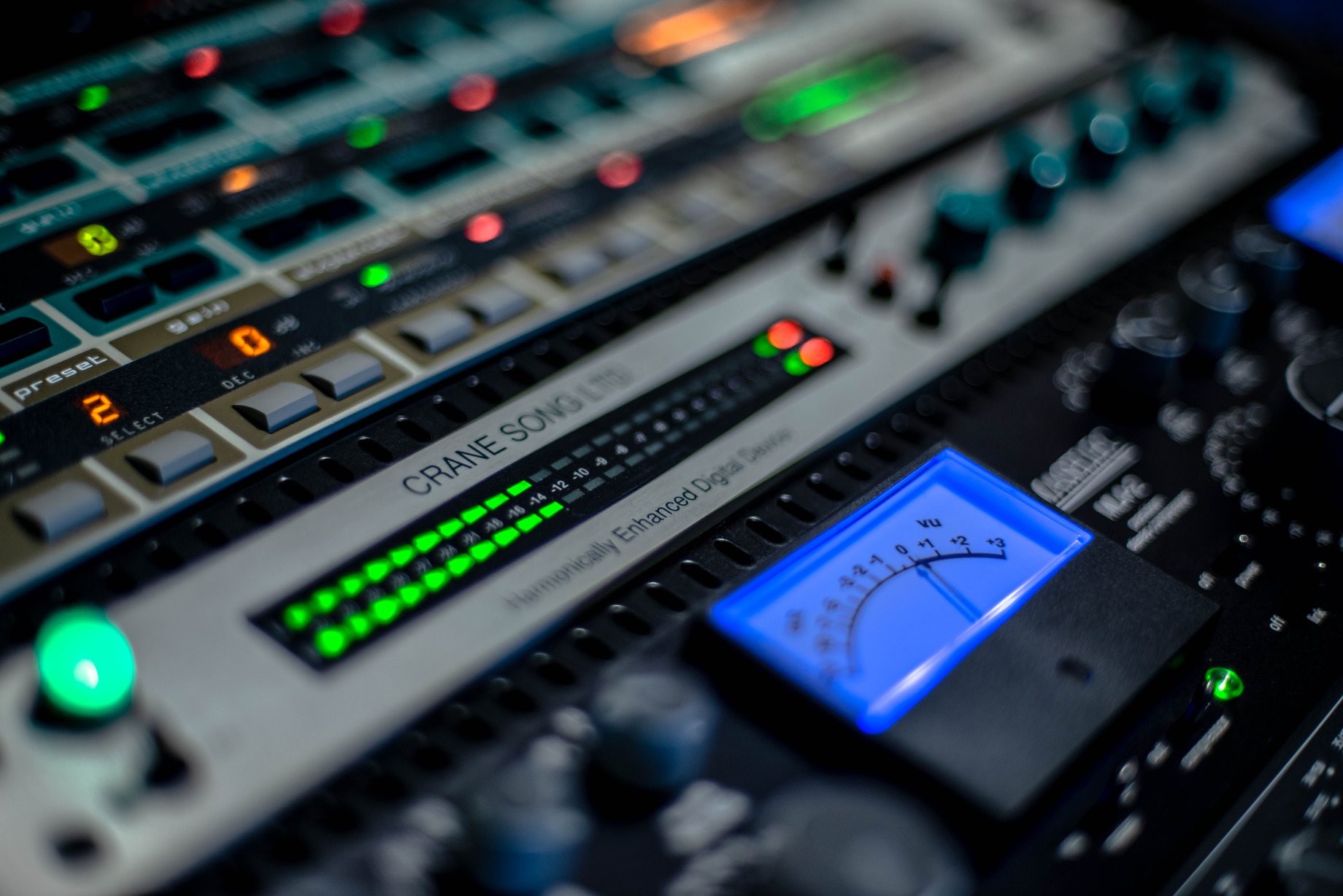
Output section and stereo image
After the inserts comes the output section, with the FX send and return at its input. The send runs at fixed 0 dB unity and the return either follows the fader or sits at a preset level, factory set at minus 10 dB and specifiable anywhere from 0 dB to minus 60 dB. The FX loop can also be flipped into a straight insert when a parallel path is not what the record needs.
Two controls shape the image, and neither uses an M-S matrix, so both stay 100 percent mono compatible:
- Elliptical filter. Steers stereo content below a point sweepable from 40 Hz to 360 Hz into the centre and removes out of phase energy without changing the mono sound. Essential for anything going to lacquer, and quietly useful on digital masters where the low end wanders.
- Stereo width. Plus or minus 100 percent of width with the mono level untouched. At minus 100 percent it collapses to mono, which pairs beautifully with the elliptical filter for phase checking.
Monitoring
The Monitor Control is the reason the room is repeatable. Stereo and six channel inputs, per channel cut, mono, phase reverse, left to right swap, main and auxiliary speaker feeds, meter sends with a switchable offset, and contact closures on a 9 way D-sub for surround, alternate speakers and meter offset so external gear and indicators follow the console. Switching between the PMC IB2 SE mains and the near fields is one button, matched in level, with no click and no glitch.
How it sits in our chain
The MTC-2's main DAC and ADC are the Prism Sound Dream ADA-8XR. That is the default path in and out of the console, and the same converters feed the Trinnov ST2 Pro for monitoring. From there the console lets us change conversion without repatching: the Crane Song HEDD, Violectric V800 and Benchmark DAC1 are selectable DAC options, and the Crane Song HEDD and Burl B2 Bomber are the alternative ADC options when a record wants a different capture.

Specification
All inputs and outputs are balanced. The signal path inputs are balanced and floating with identical impedance on pins 2 and 3, and the outputs are electronically balanced with symmetrical impedance, so level is the same balanced or unbalanced.
- Line input impedance: 50 kohm. Monitor inputs: 100 kohm. Insert returns 1 to 6: 50 kohm. FX return: 10 kohm
- Maximum input level: +28 dBu
- Transfer outputs: +29 dBu maximum, 34 ohm output impedance
- FX send outputs: +28 dBu maximum, 43 ohm. Monitor outputs: +24 dBu maximum, 66 ohm
- Transfer path noise: below minus 95 dBu. Distortion: below minus 105 dB. Dynamic range: greater than 124 dB
- Master Control 133 x 483 x 260 mm, Monitor Control 88 x 483 x 260 mm, Master Router 133 x 483 x 260 mm
A dynamic range beyond 124 dB with distortion under minus 105 dB is the number that matters. It means the console is comfortably quieter and cleaner than anything you would plug into it, including the converters, which is exactly what a transfer console is supposed to be.
Hardware info
The MTC-2 is hand built in small numbers in England and sits firmly in the five figure bracket before insert cabling and installation. It is the single most expensive line item in the room and the last thing we would ever part with.
Hear it on your record
Book a master
This chain is available on every stereo and stem master we deliver from Manchester.